A website that
sells your business.
For business owners with an outdated site, or none at all. No off-the-shelf theme, no plugin stack that breaks every six months: a site built to measure, loading fast, that you can update yourself. Fixed price up front, two to three weeks of build time.
Why people come to me.
The site is years old
Slow, not mobile-friendly and the latest news item is from 2019. Visitors draw conclusions from that about the rest of your business.
Nobody can change anything
Every text edit goes through someone else, or through an admin panel nobody has dared touch since the last update.
Google cannot find you
No structure, slow load times, no sitemap. Technically your site exists, but in the search results you sit behind your competitor.
No enquiries come in
Visitors yes, leads no. Usually because nowhere does it say clearly what you do, for whom, and what the next step is.
Maintenance keeps climbing
Plugins, licences and updates that get more expensive every year for a site that delivers nothing extra.
You started it yourself
You put something together with a builder or an AI tool, and now you are stuck on findability, speed or forms that never arrive.
From first call to live, in four steps.
Call and content plan
Which pages, which message per page, which next step you want visitors to take. If the copy does not exist yet, I write along.
Design
Structure first, then the visual design based on your brand. You see the screens before a line of code exists.
Built in Next.js
Next.js is the default: faster, easier to find and extendable. If you deliberately want WordPress, I build that too. Either way you get a CMS where you manage text, photos and pages yourself without technical knowledge.
Launch
Domain connected, SSL sorted, old URLs cleanly redirected so you keep your existing positions in Google, analytics set up privacy-friendly.
- ✓Fixed project price, known up front
- ✓A webshop is a step bigger
- ✓Two to three weeks of build time
- ✓Maintenance and support, optional
- ✓Next.js, or WordPress if you want it
- ✓Hosting inside the EU, code ownership yours
The number of pages and whether functionality is involved drive the number. You hear it after the first call, not after a quoting process.
The price depends on the number of pages and whether a webshop is part of it. After the first call you get one fixed number, not a range.
What you actually buy when you have a website built
Having a website built sounds like one job, but it is four: deciding what belongs on the site, designing that, building it, and making sure it keeps working after launch. Most quotes cover only the third part and hand you the rest, usually in the week it has to go live.
Here it runs differently. We start with structure: which pages you need, what the message per page is and which step a visitor should take. Design comes after that, code after that. If the copy does not exist yet I write along; if you already have a brand, I follow it. What that track looks like day to day is on how I work.
What you end up with is a site that is yours: your own design, your own domain, your own hosting, and the source code in your hands. No subscription holding your site hostage, no builder who is the only one with the keys.
What does a website cost?
There is no honest answer without knowing what goes on it. A five-page site for an installation company is a different animal from a site with fifty product pages, a quote form wired into your admin and two languages. Four things drive the number.
What is fixed is the shape of it: after a half-hour call you get one fixed price for the whole track. Not a range, no reconciliation afterwards, no billing by the hour. If scope changes along the way it goes through a separate agreement. How that pricing works is on pricing.
Outside the project price sits only what is predictable: domain, hosting and any licences are passed on at cost, maintenance is optional through maintenance and support. Selling from the site is a step bigger, that is on ecommerce development. Torn between paying once and paying monthly? This article lays out what you actually get either way.
Size
How many pages there are and how many of them need a design of their own. A product overview is more work than one more text page.
Functionality
Forms, multiple languages, a quote tool, an integration with your bookkeeping or stock. Every function is its own piece of building work.
Content
If copy and photos already exist it moves fast. If I write along on the copy, that counts towards the price.
Migration
Moving an existing site is more work than starting from zero: redirects, old content and existing rankings all have to come along.
Why Next.js, and when WordPress
I build in Next.js by default. Not out of fashion: it loads faster, it is technically easier to find and you are not tied to a stack of plugins needing maintenance every quarter. You do not have to make the choice yourself, and you do not have to understand any of it.
What I build with is on tech. The trade-off itself is written out in why I choose Next.js and not WordPress. If it grows into software, read on at client portal development or custom software development.
Next.js, the default here
Faster, easier to find and extendable towards a client portal, a calculation tool or an integration with your own systems. One codebase instead of a core with twenty plugins that can break.
WordPress if you ask for it
If people in your organisation already work in it, or a specific plugin runs part of your process, I build in WordPress. I do not recommend it unprompted, and I will tell you what it costs you in speed and maintenance.
Findability sits in the build, not in a package bolted on after
A site that loads slowly, has no clear heading structure and ships no sitemap ends up at the back in Google. You do not repair that with a monthly SEO subscription on top of a site that rattles technically. So the groundwork is standard.
If you already have a site, the migration matters most. Before launch I build a redirect map from every old URL to the new page, so the positions you built up move along instead of evaporating. It is the step most often skipped and the one that costs the most when you skip it: I replaced my own WordPress site and wrote up what a migration costs you in rankings.
What I will not do is guarantee you a number one spot within a month. What I will do is make sure nothing technical is in the way and that every page has one clear subject, so the content you make can actually start ranking.
- ✓Server-rendered HTML, headings that make sense
- ✓Fast load times on mobile
- ✓Title and meta per page
- ✓Structured data
- ✓Sitemap and robots.txt
- ✓Redirect map on migration
- ✓Images served at the right size
- ✓Analytics set up privacy-friendly
Build it yourself, an agency, or a freelancer
All three routes work, just not for the same situation. The full comparison is on agency, freelancer or DIY; here is the short version.
Building it yourself
With Wix, Squarespace or an AI tool you get somewhere quickly. It usually gets stuck at the same point: you want something the tool cannot quite do, or nothing can be integrated. Then you pay twice, because the builder does not move with you.
An agency
You get a team, and with it an account manager, a planning you have to fit into and an hourly rate three people write on. Fine on large tracks; for a small-business website you mostly pay for the layer in between.
One developer who builds it himself
You talk to the same person from first call to launch. Faster because nobody sits in between, cheaper because you do not pay for that layer. The limit is work that genuinely needs a whole team, and I will say so when it does.
After launch
At launch you get access to the CMS, the hosting and the domain, all in your name. You manage text, photos, pages and blog posts yourself. I walk you through it once; it does not take longer than that.
If you would rather not handle maintenance, that is available for a fixed yearly fee: updates, backups, monitoring and small text changes. You are never tied in for more than a year, and without a subscription your site is still yours. Earlier work is on work, loose questions on FAQ.
Webframer is based in Hazerswoude-Dorp, part of the Alphen aan den Rijn municipality, and I also work out of Berkel en Rodenrijs near Rotterdam. Nearby, there are separate pages for Alphen aan den Rijn and Berkel en Rodenrijs. Clients otherwise sit across the Netherlands; the first conversation works just as well over video as at a table. Want to know what your site costs, get in touch; within 24 hours of the call you have a proposal with scope, planning and a fixed price.
- ✓CMS access in your name
- ✓Domain and hosting in your name
- ✓Hosting inside the EU
- ✓Daily backups
- ✓Source code in your hands
- ✓Maintenance optional, cancellable yearly
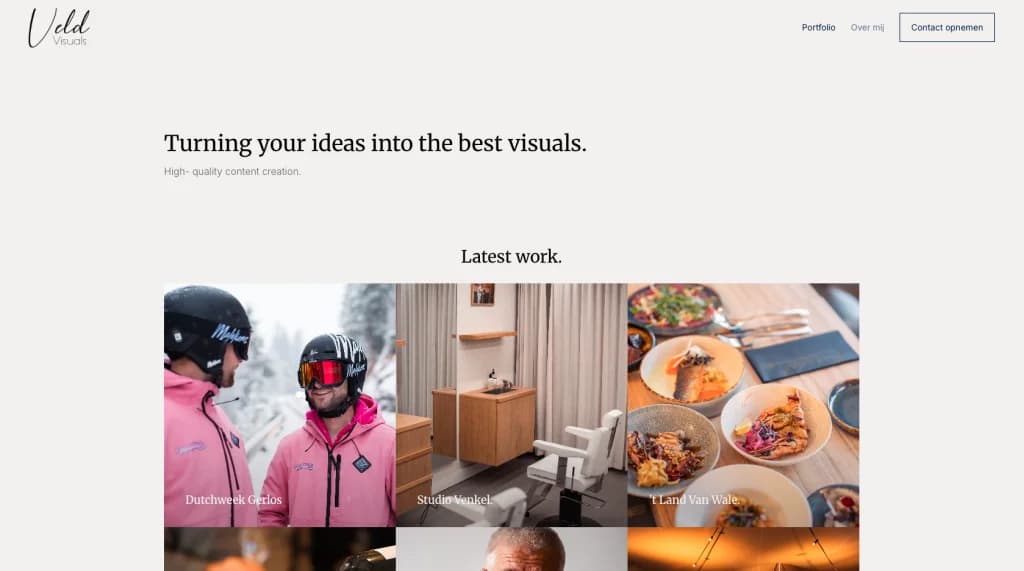
Websites in the real world


What does having a website built cost?
How long does it take?
Do you build in WordPress too?
Can I edit text and photos myself?
What happens to my current search rankings?
Is maintenance included?
What do you need from me?
Do you work on a fixed price or by the hour?
Can the site become a webshop or client portal later?
Can the website be multilingual?
Where is the hosting?
Do you only work locally?
Tell me what you
want to build.
A half-hour call. You get an honest answer about what it costs, how long it takes and whether building it is smart at all.