An app people
actually open.
For businesses and founders with an idea that belongs on a phone. I build apps for iPhone and Android from one codebase, with the backend behind it and the accounts in your name. And I will say so honestly when a web app does the same for less money.

Why app plans often stall.
Two quotes for two apps
One agency for iPhone, one for Android, and then maintenance twice. For most apps that is double work that buys nothing.
An app builder that almost fits
It started fast with a no-code tool, until you wanted something it did not have. Now you pay monthly for an app you cannot take with you.
The website is there, the phone is not
Customers use your service on the go, but the site is slow on a phone and keeps logging them out. They drop off before they have done anything.
No idea what Apple will make of it
The app is finished and gets rejected in review. Payments, privacy texts and sign-in have rules you want to know up front, not afterwards.
The app is in the agency's name
The developer account and the code belong to someone else. If you want to leave, you start again and your reviews and downloads are gone.
A prototype that cannot go live
With an AI tool there was something working on your own phone in a weekend. The step to the App Store turns out to be the real work.
From idea to an app in the store.
First the question: app or web app
Do you need the camera, notifications or offline use, or do you have to be found in the App Store? If not, a web app is often faster and cheaper, and I will tell you so.
One core feature first
The first version does one thing well. That is what you test with real users before the rest is added.
Building with a test version on your phone
From the first week there is a test version on your own device through TestFlight. You see what is being built while it is being built.
Submitting and going live
Store page, screenshots, privacy policy and the review at Apple and Google. That is part of the job, not the small print.
App or web app: what do you need?
An app is not always the right answer. A web app opens in the browser, works on every device and does not go through Apple. For an internal system or a client portal that is usually enough.
An app pays off once the phone itself has to do something, or once your customers expect to find you in the store.
| Question | Web app | App |
|---|---|---|
| Where people find it | Through a link or Google | In the App Store and Google Play |
| Camera, scanning, location | Limited | Full |
| Notifications on the device | Limited on iPhone | Yes |
| Works without internet | Barely | Yes, if built that way |
| Paying inside the app | Your own payment provider | Through Apple and Google, for a commission |
| Shipping an update | Immediately | After store review |
One codebase for iPhone and Android
I build with React Native: one app in one codebase that runs on both platforms and looks the way it should on each. That saves a second team and a second round of maintenance.
The backend is the same as for custom software: a database, sign-in with permissions and where needed an admin side in the browser.
Build once
A new feature ships on both platforms at the same time, instead of on one first and months later on the other.
Real device features
Camera, notifications, location, biometric sign-in and offline storage are simply available.
An admin side with it
You manage content, users and settings in the browser, without a new app version for every change.
Your existing system behind it
If you already have software or a webshop, the app talks to it through [integrations](/koppelingen-laten-maken) instead of a second administration.
What the App Store involves
The store has its own rules, and they decide more of the design than people expect. It is cheaper to include them in week one than after a rejection.
- Developer accounts at Apple and Google in your name
- Digital purchases go through the store, for a commission
- Privacy policy and a declaration of the data you collect
- Deleting an account has to be possible inside the app
- Every version goes through review first
- Store page with screenshots and copy per language
My own app as proof
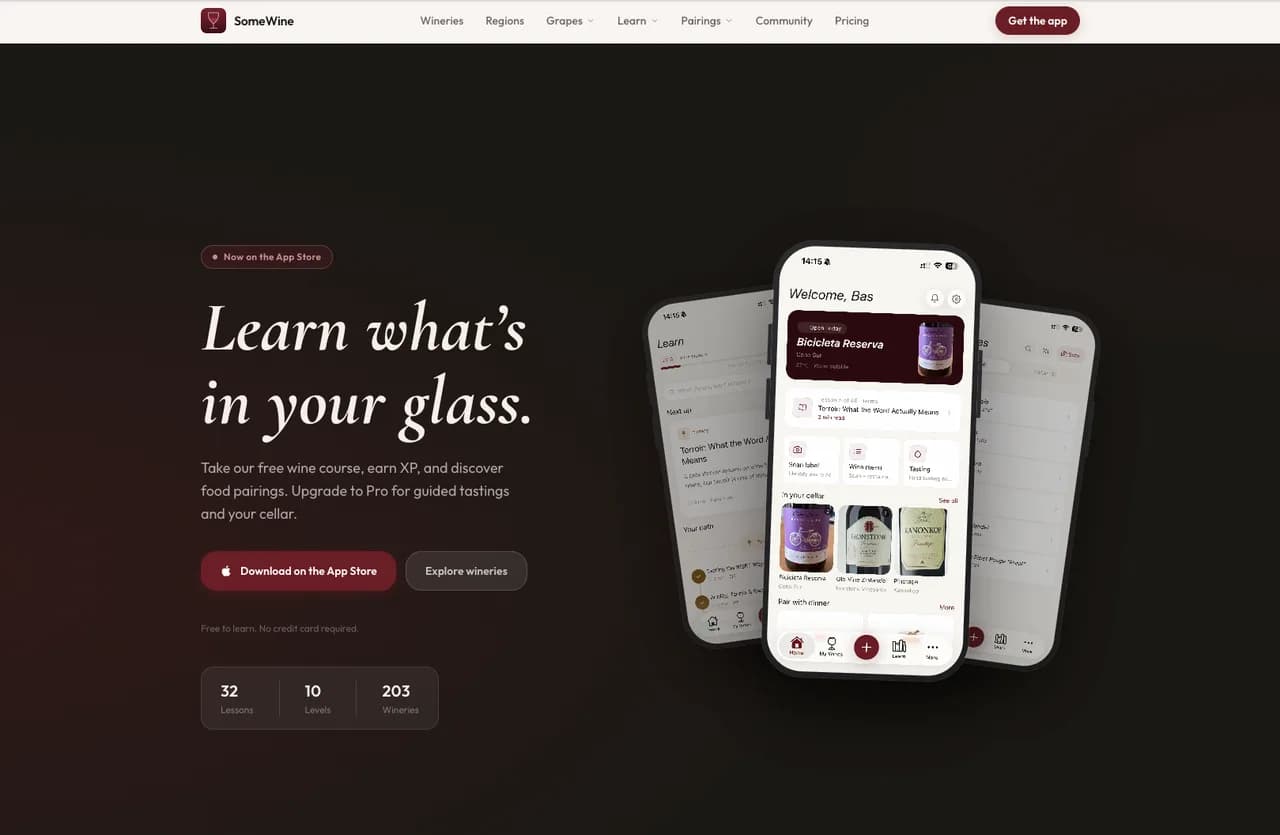
SomeWine is an app I built myself and that is live in the App Store: a free wine course, label scanning with the camera and keeping your own cellar, with a Pro subscription billed through the store. Everything above I went through there myself, review included.
If you already have a prototype from an AI tool, vibecode to production is the starting point: I look at what is there and what it needs to get into the store.
Apps in the real world
Clients rate me 5 stars on average.
“I am extremely happy with the result of my new website for DoubleStreet Australian Cobberdogs, made by Webframer. From first contact, Webframer radiated expertise and creativity.”
“Webframer helped me enormously with the Veldvisuals website. It is not only good to spar with Bas about building the site, but also in the aftercare and whenever changes have to be made. Recommended!”
“Great to work with. Listens carefully to what we want. When we ask for changes, they are made expertly.”
“Really pleasant to work with and short lines of communication!”
“The website looks great!! Definitely recommended!”
“Excellent! Fast service and good contact!”
Translated from the Dutch originals on Google.

I am Bas Voets. Since 2021 I have been building websites, client portals and business software for small and mid-sized companies, from Hazerswoude-Dorp in the Netherlands. From first call to launch you talk to me, not to an account manager.
What does it cost to have an app built?
Do you build for iPhone and Android?
Do I need an app, or will a web app do?
Whose name is the app under in the store?
How long does Apple's review take?
What does it cost to keep an app running?
Tell me what you want to build.
A half-hour call. You get an honest answer about what it costs, how long it takes and whether building it is smart at all.