A webshop that
sells and adds up.
Selling is one thing; shipping, stock, VAT and invoices that land in your accounting by themselves is the real work. I build webshops where the back end is as well sorted as the shop window. Fixed price up front, no reckoning afterwards.
Where webshops get stuck.
Checkout takes too many steps
Every extra click between basket and payment costs revenue. Without iDEAL and without guest checkout, part of your customers will drop out, guaranteed.
Stock levels are wrong
You sell something that already left the shop, or you dare not list anything online for fear of overselling.
Everything gets retyped
Orders keyed into the accounting by hand, shipping labels created separately, invoices emailed apart. That work does not scale with your growth.
Slow on mobile
Most of your traffic comes from a phone. Heavy themes and uncompressed product photos cost you sales right there.
Invisible in Google
Product pages without structured data do not appear with price, stock and reviews in the search results. Your competitor does.
Plugins that fight each other
A shop floating on ten extensions breaks with every update. Usually in exactly the weekend of your campaign.
From product range to first order.
Map the range and the flow
How many products, which variants, how you ship, which VAT rates and where your stock lives today. The rest of the build hangs off that.
Design aimed at checkout
Product pages and checkout first, the rest after. The path to the button matters more than the homepage.
Payments and integrations
iDEAL, credit card and pay-later through Mollie or Stripe. Orders, invoices and stock connected to your accounting and shipping partner.
Live and measured
Products in Google Merchant, structured data for price and stock, and insight into where visitors drop out.
- ✓Fixed project price, known up front
- ✓iDEAL and the common payment methods
- ✓Connected to accounting and shipping
- ✓Live in three to four weeks
- ✓Maintenance and support, optional
The number of products, the variants and the integrations drive the number. Transaction fees go straight to your payment provider, not to me.
The price depends on the number of products, variants and the integrations you need. After the first call you get one fixed number.
What makes a custom webshop different
A custom webshop is not necessarily prettier than a well-configured Shopify or WooCommerce store. The difference is what becomes possible once the way you sell differs from what a platform expects. As long as you sell separate products at a fixed price, a package is almost always the smarter choice, and I will say so.
Custom starts to pay off the moment you do something the platform does not know. In practice that is four situations.
Your own pricing rules
Volume tiers, customer-specific prices, price per square metre or per configuration. Anything that is not one number per product becomes a stack of plugins in a package.
Integrations that go further
Your stock in another system, your invoices in your bookkeeping, your orders in your own planning. Any platform does one integration; three systems working together reliably is custom work.
Products that get configured
Choose, combine, calculate and only then order. A configurator running on your rules does not fit a standard product page.
Speed and findability
Your own codebase loads faster and gives you full control over structured data, canonicals and filter pages. With hundreds of products that is worth positions.
A design of your own, not a theme
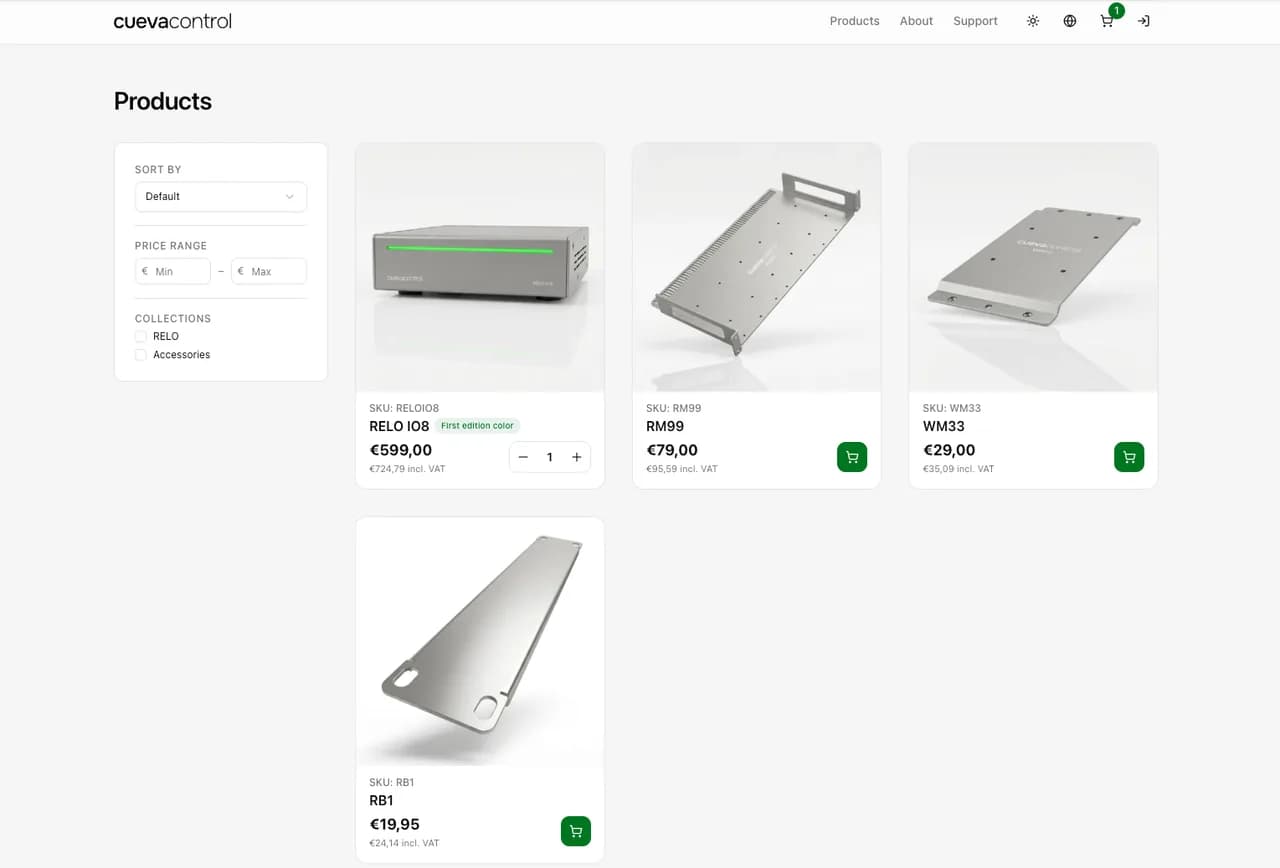
What people usually mean by a custom webshop is the design: not a theme with your logo dropped in, but a store that looks like your brand. That starts at the product page and the checkout, not the homepage, because that is where selling happens.
The design follows your brand and your range: how many variants each product has, whether there is a lot of imagery, and whether people compare before they choose. You see the screens before a line of code exists.
- ✓Your own design, no off-the-shelf theme
- ✓Product page and checkout first
- ✓Fast on mobile, even with heavy imagery
- ✓Structured data for price and stock
- ✓Filters and variants without a plugin stack
- ✓Manage products and copy yourself
What a webshop costs
The price does not move with the number of products but with the number of exceptions. Importing a thousand articles in the same setup is an afternoon; fifty articles each priced, packed or shipped differently is a project.
What is fixed is the shape: after a half-hour call one fixed price for the whole track. How that pricing works is on pricing, and what an ordinary site involves on website development. The choice between payment providers is set out in Stripe or Mollie, and maintenance afterwards runs through maintenance and support.
Range and variants
How many products, how many variants each, and whether configurations or bundled articles are involved.
Integrations
Bookkeeping, stock, carrier, point of sale. Every source that has to come along is its own piece of work and the biggest cost item.
Payment and shipping logic
iDEAL and card are standard. Pay later, business invoicing, foreign VAT or your own shipping rates are extra work.
Migration
Moving an existing shop costs more than starting from zero: products, customers, orders and a redirect for every old product URL.
Selling to businesses?
Then different rules apply: logins for your customers, agreed prices per account, minimum order quantities, ordering on account and usually an integration with your ERP or bookkeeping. That is a different kind of project from a consumer webshop.
What that involves is on B2B webshop development. If it is mainly about insight and documents rather than ordering, you want a B2B portal for your trade partners, or a client portal for your end customers.

What does having a webshop built cost?
Do you work with WooCommerce or Shopify?
What is the difference between a custom webshop and a standard package?
What does a custom webshop cost?
Can my stock update automatically?
What about VAT and invoices?
Can my current webshop be migrated?
Tell me what you
want to build.
A half-hour call. You get an honest answer about what it costs, how long it takes and whether building it is smart at all.